
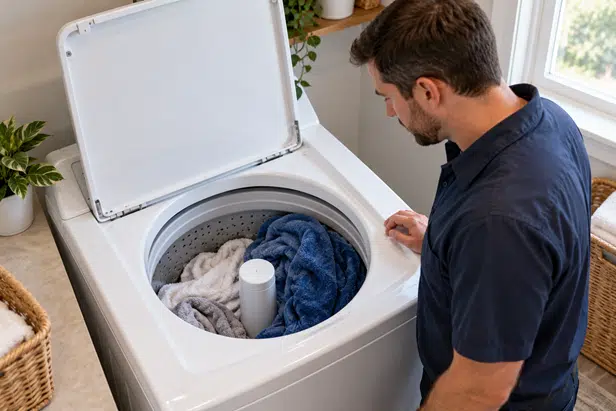
A Whirlpool washer that won’t spin does not automatically need a motor. Before considering parts, separate three situations: the washer is deliberately using a slow spin, it cannot proceed because another condition remains unresolved, or it attempts to spin and fails.
This guide helps you organize those observations. Whirlpool has used different washer platforms, so apply only the instructions that match your complete model number and owner’s manual.
⚠️ SAFETY FIRST: Always unplug the appliance you're working on from the wall outlet, turn off the breaker, or both, to completely disable power before opening the top console or touching electrical wiring.
Before testing: protect yourself and the appliance
Never bypass a lid switch or door lock to watch the basket operate. Keep hands clear of moving parts, and wait for the washer to stop and unlock normally before touching the load. Disconnect power before any inspection requiring access beyond normal user controls.
Stop operation for a burning smell, a leak near electrical equipment, severe grinding, or violent movement. Do not hold a shaking washer in place while it runs. Internal electrical or drive-system testing belongs with someone equipped to follow the model’s service procedure safely.
Listen: when does the expected spin fail?
Note the sequence rather than writing only “no spin.” Does the washer complete washing? Is water still visible? Does it lock, pause, and stop? Does the basket begin moving but never reaches the expected speed?
Record the selected cycle, load type, spin setting, and any displayed code. Note whether the problem happens with every load or primarily with one item, such as a heavy blanket. Those details help distinguish a repeatable machine fault from a load-dependent interruption.
Do not use motor noise alone as proof that the basket is turning correctly. Observe only through the normal viewing area, without opening or defeating a safety device.
Observe: check the selected spin setting
Low Spin, No Spin, and gentler fabric cycles can leave more moisture in clothing. Check the actual options before concluding that extraction has failed. Use only a spin speed suitable for the garments. Whirlpool’s front-load guidance also identifies excess suds and a single bulky item as conditions to review when clothes remain wet. Whirlpool: front-load spin checks for the covered laundry-tower models
A washer set to a protective cycle may be doing what it was asked to do. The useful question is whether its performance matches that cycle and load—not whether every load comes out equally dry.
Observe: separate water retention from poor extraction
If water remains visibly pooled in the tub, address drainage before interpreting the symptom as an isolated spin failure. Whirlpool identifies a kinked, obstructed, or incorrectly installed drain hose as a possible contributor to interrupted spinning. A lid or door that is not securely latched can also prevent operation. Whirlpool: reasons a washer may not spin
Look for clothing caught in the closure and close it normally. Do not force the latch, tape it closed, or infer that a clicking lock is electrically proven good. Record any lock-related message for the appropriate model-specific procedure.
Test: correct load and installation issues first
An uneven load can cause reduced speed, repeated attempts to redistribute clothing, or an interrupted spin. Once the machine has stopped and unlocked, rearrange the load according to the manual. Avoid tightly packing the basket, and choose the cycle intended for the items being washed.
Check whether the washer is level and stable without tipping it or reaching underneath it. If adjustment is needed, use the installation instructions or arrange help. Whirlpool lists load imbalance, leveling, and an interrupted power supply among its top-load spin checks. After correcting a suitable load issue, use the manual’s recommended drain/spin selection and observe the result. Whirlpool: top-load spin checks
Do not keep restarting a machine that repeatedly strikes the cabinet or fails the same way. Repetition without a changed condition adds little diagnostic information.
Confirm: compare the result with the original complaint
Did the washer finish the selected cycle? Did visible standing water disappear? Did the corrected load reach an appropriate spin without excessive movement? Note exactly which change improved the result.
If it spins with a properly arranged load but fails with a particular bulky item, revisit that item’s loading and cycle requirements. If it still fails under the manual’s recommended conditions, move to the technical sheet for that model rather than ordering a generic “no-spin” part.
Use an actual code to choose the next guide
If one of these codes is recorded, use the corresponding AFC article only after confirming model applicability:
These links are diagnostic routes for recorded codes, not a list of parts to replace. Test It Before You Replace It.