

Encountering a Whirlpool washer F7E2 error code (also displayed as F07E02 on digital top-load displays) indicates a Drive Motor Alignment Fault. This specific diagnostic code is primarily found on Whirlpool, Maytag, Amana, and Kenmore Vertical Modular Washers (VMW) and Cabrio/Bravos top-load platforms. It triggers when the main control board (ACU) commands the shift actuator to transition the gearcase between agitate and spin modes, but the optical speed sensor fails to detect that the mechanical shift successfully occurred.
When an F7E2 fault registers, the washer will typically halt mid-cycle, leaving clothes soaking wet, or refuse to spin and agitate altogether.
⚠️ SAFETY FIRST: Always unplug the appliance you're working on from the wall outlet, turn off the breaker, or both, to completely disable power before opening the top console or touching electrical wiring.
In the vast majority of cases, an F7E2 code is caused by a stripped or bound-up Splutch (spline and clutch) assembly, a mechanically failed shift actuator, a broken splutch cam spring, a heavy object restricting tub movement or garments stuck between the basket and tub wall.
What Triggers the Whirlpool Washer F7E2 Error Code?
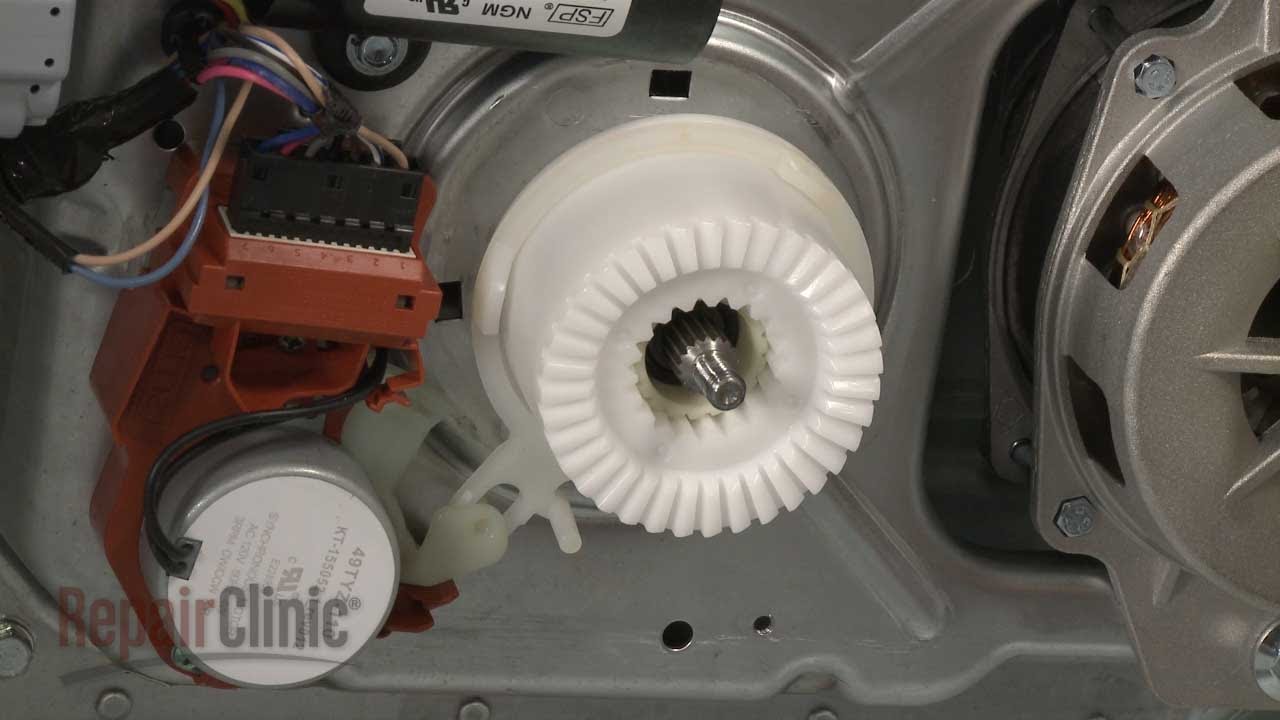
Unlike traditional direct-drive washers, modern Whirlpool top-loaders use a single drive motor and a plastic mechanical clutching mechanism—called the Splutch—to shift the machine between agitation and high-speed spin.
A small electric motor called the shift actuator pulls a plastic shift arm, which moves the splutch slider up and down to engage or disengage the gearcase gear teeth. Simultaneously, an optical sensor on the actuator reads a target ring on the transmission pulley to verify movement. If the control board attempts to shift modes but the optical sensor reports that the drive teeth are not locked into their new position, it assumes the drivetrain is jammed and throws the F7E2 code.
Common failure points include:
- A broken, stretched, or missing splutch cam return spring (the large spring on the bottom pulley).
- Stripped plastic gear teeth on the splutch slider or drive pulley.
- A failed synchronous motor inside the shift actuator, rendering it unable to pull the shift arm.
- A broken plastic shift arm linkage, a common precursor to a Whirlpool F7E5 actuator fault.
- A faulty optical sensor struggling to read the pulley RPM, which can also trigger a Whirlpool F7E1 speed sensor error.
Step-by-Step Diagnostic & Repair Guide
⚠️ Safety Warning: Always unplug the washing machine from the wall outlet before tipping it backward or accessing the bottom drive components.
Step 1: Mechanical Inspection of the Splutch Assembly
Most F7E2 errors are physical, not electrical. You will need to access the underside of the washer to inspect the drive components.
- Securely tape the lid shut and carefully tilt the washer backward against a wall or lay it gently on its front panel to access the bottom drivetrain.
- Locate the Splutch assembly (the large plastic pulley, gear, and spring mechanism mounted to the center shaft).
- Inspect the Spring: Verify that the large metal compression spring is fully intact, seated properly, and providing tension. If it is broken or missing, the splutch cannot engage, and the whole assembly must be replaced.
- Inspect the Shift Arm: Check the plastic actuator shift arm (the lever that the actuator pulls). If the plastic ring holding the splutch is cracked or the linkage pin is snapped, it cannot move the gear.
- Check for Binding: Rotate the main drive pulley by hand. It should rotate freely in one direction (engaging the tub) and have heavy resistance in the other (engaging the agitator). If it grinds loudly or feels locked up, the splutch gear teeth are likely stripped.
Step 2: Test the Shift Actuator Motor and Sensor
If the splutch components are physically intact, the shift actuator may have suffered an electrical failure. Disconnect the 6-pin wire harness from the shift actuator and set your digital multimeter to Resistance (Ohms / Ω) or DC Volts.
| Component / Test Point | Expected Electrical Spec | Diagnostic Verdict |
| Actuator Motor (Pins 2 & 3) | 2,000 Ω to 3,500 Ω (2k to 3.5k Ohms) | PASS: The synchronous shifting motor has continuity. |
| Actuator Motor (Pins 2 & 3) | Open Circuit (OL) or Infinite | FAIL: The actuator motor is burned out. Replace the Shift Actuator. |
| Optical Sensor Power (Pins 1 & 4 on ACU Harness) | +13 VDC Constant (With machine plugged in) | PASS: Main control board is sending correct logic voltage to the sensor. |
| Tachometer Signal (Pins 4 & 5) | Toggles between 0 VDC and +5 VDC (When manually rotating pulley) | PASS: The optical sensor is correctly reading the pulley movement. |
(Note: If the actuator motor is burned out or the optical sensor fails to output a +5 VDC toggling signal, the entire shift actuator assembly must be replaced.)
Calibration & Diagnostic Modes by Machine Type
Any time you replace a Splutch assembly, a shift actuator, or clear a drivetrain obstruction, you must run an automatic calibration cycle. This forces the control board to relearn the mechanical limits of the shift linkage and prevents the F7E2 code from immediately returning.
Category 1: Rotary Knob Top Loaders (VMW Platform)
Examples: Whirlpool WTW5000DW, Maytag MVWC565FW, Amana NTW4516FW
- Clear Memory: Turn the cycle selector dial counterclockwise 1 full rotation to clear dial positioning.
- Enter Service Mode: Turn the dial Right 3 clicks, Left 1 click, and Right 1 click within 6 seconds. All green status lights will flash when successful.
- Run Calibration: Rotate the dial until only the Rinse status LED is illuminated. Ensure the washer tub is completely empty (no clothes, no water), then press START. Allow the machine to run its full 2-to-4 minute self-calibration sequence.
Category 2: Push-Button / Digital Touch Top Loaders (Cabrio, Bravos, Smart Series)
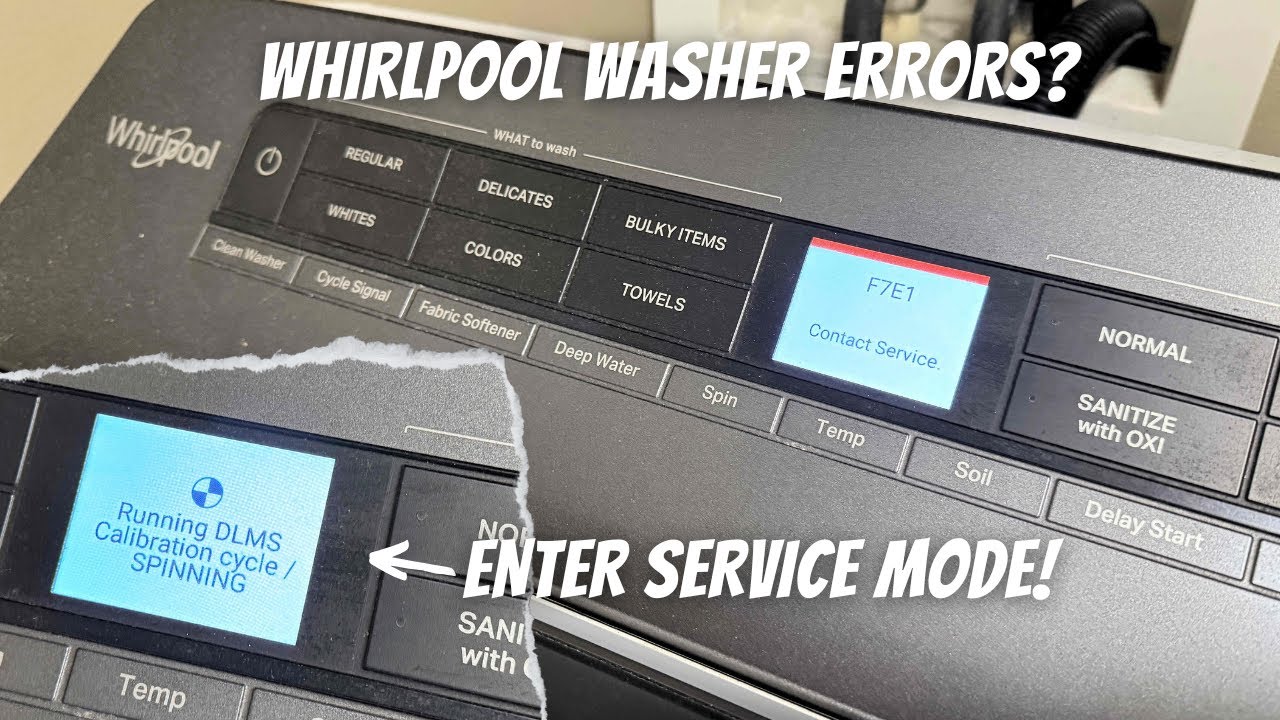
Examples: Whirlpool WTW8500DC, Maytag MVWB835DW, MVW6230HC
- With the machine in Standby mode (plugged in with screen off), choose any 3 non-power control buttons.
- Press the 3 buttons in sequence: 1 – 2 – 3, 1 – 2 – 3, 1 – 2 – 3 within 8 seconds.
- All console lights will illuminate to verify active Service Mode.
- Press Power / Cancel once to clear historical error codes, then press Start while code
88orC0displays to initiate the automated diagnostic and calibration test.
Category 3: Front-Load Washers (Duet, Epic, Modern Front Loaders)
Note: Front-load washers do not use a splutch mechanism and rarely trigger an F7E2 code. If a drive alignment fault registers on a front-loader, it typically indicates a Whirlpool F7E6 main motor circuit failure or MCU communication fault. However, to clear memory and test:
- Ensure the machine is in Standby mode (powered off, plugged in).
- Select any control button (except Power) and perform: Hold 3 seconds -> Release 3 seconds -> Repeat 3 times.
- Saved diagnostic codes will display on screen. Press Power / Cancel to erase historical error logs and exit.
Video Guide: Washer Splutch & Actuator Replacement
If your inspection reveals a broken spring, stripped gear, or faulty actuator, replacing the Splutch assembly and Shift Actuator is a straightforward repair that takes about 20 minutes from the bottom of the machine.
How to Clear the F7E2 Error Code
- Clear the Drivetrain: Ensure the drive pulley, splutch cam, and belt are free from obstructions and the actuator linkage is fully seated.
- Hard Reset: Unplug the washing machine from the wall for 5 minutes to discharge board capacitors and erase immediate volatile memory.
- Calibrate: Plug the machine back in and run the platform-specific Calibration Mode detailed above. The control board must test the mechanical shift linkage in real-time to permanently clear the F7E2 status.
Related Diagnostic Guides
Resolving Your Whirlpool Washer F7E2 Error Code
Troubleshooting a Whirlpool washer F7E2 error code or Maytag washer F7E2 error code requires looking past the digital display and inspecting the physical mechanical drivetrain beneath the tub. By visually verifying the integrity of the splutch gear and cam spring, confirming 2,000 to 3,500 Ω resistance on the shift actuator motor, and running a fresh calibration cycle, you can successfully restore drive alignment and get your washer shifting smoothly again. Thanks for stopping by!